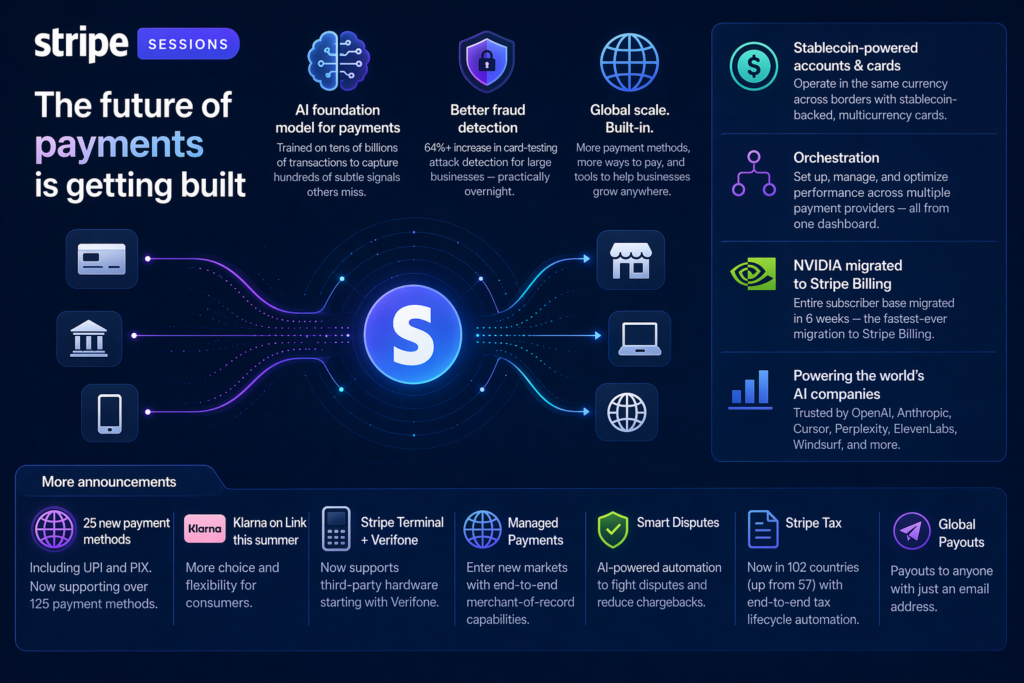
Stripe’s new AI foundation model increased detection rates for card-testing attacks on large businesses by 64% practically overnight, according to TechCrunch. For mid-size banks and community financial institutions still relying on rule-based fraud systems, this development creates immediate pressure to evaluate AI-powered fraud detection capabilities — and specific implementation requirements that didn’t exist six months ago.
The performance leap isn’t incremental. While Stripe’s previous models gradually reduced card-testing attacks by 80% over two years, the new foundation model delivered a dramatic improvement in detection speed. This creates a competitive gap that community banks and fintechs can’t ignore, especially when competing against institutions that can integrate with Stripe or similar AI-powered payment processors.
What Stripe’s AI Foundation Model Actually Does
Stripe’s payments foundation model has been trained on tens of billions of transactions, giving it access to pattern recognition that smaller institutions simply cannot replicate in-house. As Emily Glassberg Sands, Stripe’s head of information, explained: “Previously, we couldn’t take advantage of our vast data. Now we can.”
The model “captures hundreds of subtle signals about each payment” that traditional rule-based systems miss. Card-testing attacks — where fraudsters systematically test stolen card information to determine validity — represent one of the most expensive fraud types for mid-size institutions. These attacks often fly under the radar of conventional fraud rules because individual transactions appear normal.
What makes this development significant for community banks is the speed of improvement. The 64% overnight improvement in detection rates suggests that AI-powered fraud detection has reached a maturity level where implementation delivers immediate results, not gradual improvements over quarters.
Stripe isn’t alone in this space. Sardine, which describes itself as an AI risk platform for fraud, compliance, and credit underwriting, raised a $70 million Series C funding round led by Activant Capital in February, according to TechCrunch. This indicates significant investor confidence in AI fraud detection solutions designed for mid-market financial institutions.
Implementation Requirements for Community Banks and Fintechs
Mid-size banks face specific challenges when implementing AI fraud detection that differ from both large banks and pure fintech startups. Community banks typically process between 10,000 to 500,000 transactions monthly — enough volume to benefit from AI detection but not enough to train models in-house.
The core implementation requirement is data pipeline integration. AI fraud models need real-time transaction data, customer behavior patterns, and historical fraud outcomes. For community banks running legacy core banking systems, this means establishing API connections between existing transaction processing and new AI fraud detection platforms.
Budget considerations become critical. While Stripe’s enterprise pricing isn’t publicly disclosed, similar AI fraud detection services for mid-size institutions typically range from $15,000 to $75,000 annually, plus per-transaction fees. Community banks with assets under $1 billion need solutions that deliver measurable ROI within 12 months.
Compliance integration represents another implementation requirement. AI fraud detection systems must integrate with existing Bank Secrecy Act (BSA) monitoring and suspicious activity reporting processes. The OCC’s guidance on AI model risk management requires banks to understand how AI models make decisions, which can be challenging with foundation models trained on proprietary datasets.
Team requirements are manageable but specific. Implementation typically requires one technical resource familiar with API integration, plus one compliance officer who understands fraud monitoring workflows. The technical lift is lighter than building in-house AI capabilities but heavier than implementing traditional rule-based systems.
What Community Bank CTOs Should Do This Quarter
Start with a fraud detection audit of current capabilities. Document your institution’s card-testing attack detection rate, false positive rates, and manual review volume. Most community banks discover they’re missing 30-50% of sophisticated card-testing attacks when they benchmark against AI-powered detection.
Request demonstrations from three AI fraud detection vendors specifically designed for mid-size institutions. Beyond Stripe (which requires using Stripe as a payment processor), consider vendors like Sardine, Feedzai’s community bank solutions, or SAS Fraud Management for smaller institutions. Each demo should include processing a sample of your actual transaction data to demonstrate detection improvement.
Evaluate data readiness. AI fraud detection requires clean, real-time transaction data feeds. If your core banking system struggles to provide real-time transaction APIs, budget for middleware solutions. This infrastructure investment often represents 40-60% of total implementation costs but enables multiple AI applications beyond fraud detection.
Engage your compliance team early. AI fraud detection changes existing fraud monitoring workflows and may require updates to BSA monitoring procedures. Compliance officers need time to understand how AI-generated fraud scores integrate with suspicious activity reporting requirements.
Plan for a three-month implementation timeline. Month one focuses on data integration and testing. Month two involves parallel running with existing fraud rules. Month three includes compliance validation and staff training. This timeline assumes your institution has basic API capabilities and dedicated technical resources.
Common Implementation Mistakes That Cost Time and Money
The biggest mistake community banks make is treating AI fraud detection as a direct replacement for existing rule-based systems. AI models work best when layered with traditional rules, not as complete replacements. Plan for a hybrid approach where AI handles pattern recognition and traditional rules handle regulatory compliance requirements.
Another common error is underestimating data quality requirements. AI fraud detection models need consistent data formatting, complete transaction metadata, and reliable real-time feeds. Many community banks discover their transaction data lacks sufficient detail for effective AI analysis only after starting implementation.
Budget planning often focuses solely on software licensing costs while ignoring integration and training expenses. Factor in API development, compliance process updates, and staff training. Total implementation costs typically run 2-3 times the annual software licensing fee.
Vendor selection mistakes happen when institutions choose solutions designed for either very large banks or small merchants. Mid-size institutions need solutions that handle moderate transaction volumes efficiently while maintaining compliance capabilities. Pure fintech solutions often lack banking compliance features, while enterprise solutions may be over-engineered for community bank needs.
Bottom Line for Community Bank CTOs
Stripe’s 64% overnight improvement in card-testing detection represents the performance gap that community banks now face when competing against institutions using AI-powered fraud detection. Implementation is no longer a future consideration — it’s a current competitive requirement. Budget $25,000-$50,000 for comprehensive implementation at a typical community bank, plan for three months of integration work, and start with a fraud detection audit to establish baseline performance metrics.
Key Takeaways
- Stripe’s AI foundation model improved card-testing attack detection by 64% practically overnight, creating immediate competitive pressure for community banks using traditional fraud rules
- Implementation requires API integration, compliance process updates, and 3-month timeline with dedicated technical and compliance resources
- Total costs typically range from $25,000-$75,000 annually including integration, with ROI dependent on current fraud loss rates and false positive reduction
The question for community bank CTOs isn’t whether to implement AI fraud detection, but how quickly you can evaluate options and begin integration. Are you prepared to benchmark your current card-testing detection rates against AI-powered alternatives this quarter?
Source: TechCrunch
Pingback: Why AI Document Fraud Detection Creates Hidden KYC Vendor Selection Risk for Community Banks - AI Fintech Insider
Pingback: Treasury AI Risk Framework 230 Controls Hit Community Banks — Vendor Due Diligence Guide - AI Fintech Insider