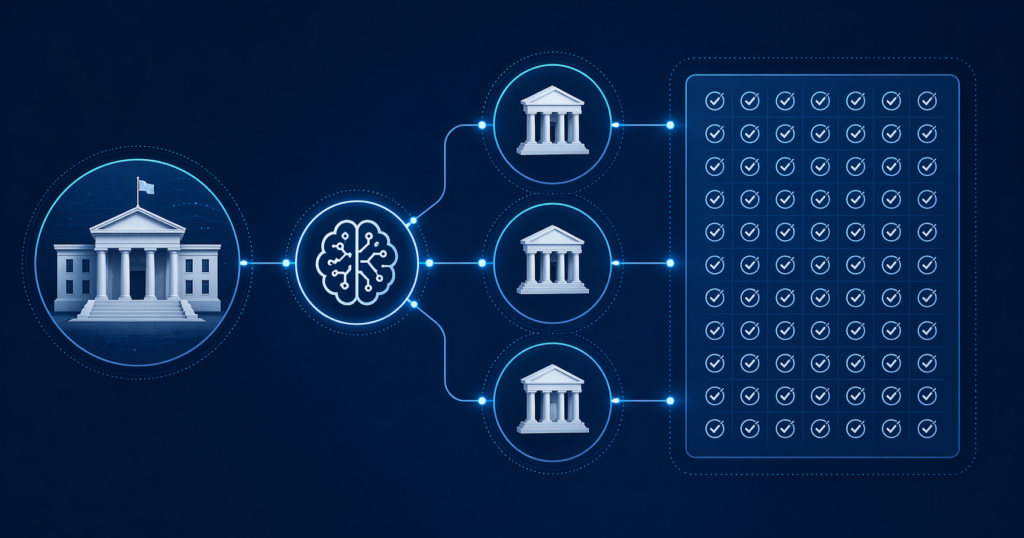
The Treasury Department just dropped a matrix with 230 control objectives for managing AI risks across the entire technology lifecycle — and if you’re running technology or compliance at a community bank, this isn’t just another regulatory document to file away. According to American Banker, this Financial Services AI Risk Management Framework creates specific requirements that will change how you evaluate and monitor every AI vendor relationship.
While Treasury Secretary Scott Bessent positioned this as collaboration to “support secure AI adoption that increases the resilience of our financial system,” the practical reality is more complex. Your bank now has a detailed checklist that examiners will expect you to use when assessing everything from chatbots to fraud detection systems.
What Treasury’s 230 AI Controls Actually Cover
The framework emerged from the Artificial Intelligence Executive Oversight Group, a public-private partnership between the Financial Services Sector Coordinating Council (FSSCC) and the Financial and Banking Information Infrastructure Committee (FBIIC). According to American Banker, the FSSCC includes more than 70 organizations, while the FBIIC consists of 18 federal and state regulatory organizations.
The 230 control objectives span the complete AI lifecycle, from initial vendor selection through ongoing monitoring and eventual decommissioning. This isn’t a high-level governance document — it’s an operational checklist that covers data integrity, model validation, bias testing, explainability requirements, and incident response procedures.
Treasury’s Assistant Secretary for Financial Institutions Luke Pettit chairs the regulatory committee, while Deborah Guild of PNC chairs the industry side alongside Vice Chair Heather Hogsett of the Bank Policy Institute. The framework builds on their previous collaboration — in July 2024, according to American Banker, these same groups published tools for secure cloud computing adoption.
The timing isn’t coincidental. As Paras Malik, Treasury’s chief artificial intelligence officer, noted: “Clear terminology and pragmatic risk management are essential to accelerating AI adoption in financial services.” The framework aims to reduce uncertainty and support consistent implementation across institutions of all sizes.
The Vendor Due Diligence Gap This Creates for Community Banks
If you’re a CTO at a community bank or credit union, you’re now facing a documentation problem that most of your current AI vendors aren’t prepared to address. The framework doesn’t just suggest best practices — it creates an expectation that you can demonstrate compliance with specific control objectives during examinations.
Your fraud detection vendor might have SOC 2 compliance and general AI governance statements, but can they provide documentation showing how they handle model drift detection? Do they have bias testing protocols that align with the framework’s requirements? Can they demonstrate data lineage for the training datasets they use?
The challenge compounds when you consider that community banks typically work with multiple AI vendors — one for loan origination, another for customer service chatbots, a third for BSA monitoring. Each vendor relationship now requires evaluation against the same 230 control objectives, but most vendors haven’t structured their compliance documentation to match Treasury’s framework.
This creates a particular burden for smaller institutions that lack dedicated AI governance teams. Unlike the major banks represented in the FSSCC development process, community banks often have one or two people handling all technology vendor relationships. Those individuals now need expertise in AI model validation, algorithmic bias detection, and explainability requirements.
Immediate Action Plan for Community Bank Technology Teams
Start with an inventory of your current AI implementations — not just the obvious ones like chatbots, but embedded AI in your core banking system, loan origination platform, fraud monitoring, and customer onboarding processes. Many community banks discover they’re using more AI than initially realized.
Next, request AI governance documentation from each vendor. Don’t accept generic responses about “following industry best practices.” Ask specifically for their model validation procedures, bias testing methodologies, data governance controls, and incident response protocols. Request evidence that they can provide ongoing monitoring reports and model performance metrics.
Create a simple tracking spreadsheet mapping each AI vendor against the framework’s key control categories. You don’t need to address all 230 controls immediately, but focus on the highest-risk areas: data integrity, model explainability, bias detection, and security controls. This gives you documentation for examiner conversations and identifies gaps requiring attention.
For new vendor evaluations, incorporate framework requirements into your RFP process. Ask vendors to demonstrate compliance with relevant controls and provide ongoing reporting capabilities. This shifts the compliance burden to vendors while ensuring you can meet examination expectations.
Consider joining industry groups focused on AI governance for community banks. The OCC’s guidance on model risk management provides additional context for implementing these controls at smaller institutions.
Common Implementation Mistakes Community Banks Make
The biggest mistake is treating this as a one-time compliance exercise. The framework emphasizes ongoing monitoring and continuous validation throughout the AI lifecycle. Simply checking boxes during vendor selection isn’t sufficient — you need systems for ongoing oversight and periodic reassessment.
Another common error is trying to apply every control to every AI implementation regardless of risk level. A simple chatbot that handles basic account balance inquiries doesn’t require the same validation rigor as an AI system making lending decisions. Focus your detailed compliance efforts on higher-risk applications.
Don’t underestimate the documentation requirements. Examiners will expect clear evidence of your AI governance processes, vendor oversight procedures, and ongoing monitoring activities. Generic vendor assurances and informal oversight processes won’t meet examination standards under this framework.
Many institutions also fail to coordinate between their technology, compliance, and risk management teams when implementing AI governance. The framework requires cross-functional collaboration — your BSA officer needs to understand how AI impacts AML monitoring, your lending team needs to grasp fair lending implications of AI-driven decisions, and your IT team needs compliance expertise for vendor management.
Bottom Line for Community Bank CTOs
This framework transforms AI vendor management from a technology procurement issue into a comprehensive risk management requirement. You now need documented processes for evaluating, monitoring, and validating AI systems that most community banks haven’t developed yet. The good news is that you have time to build these capabilities gradually, but you need to start now because examination expectations have changed permanently.
Key Takeaways
- Treasury’s new framework includes 230 specific control objectives that create documentation requirements for every AI vendor relationship at your bank
- Start immediately with an AI inventory and vendor documentation requests — most vendors aren’t prepared to provide framework-compliant governance evidence
- Focus on higher-risk AI implementations first, but develop ongoing monitoring processes rather than treating this as one-time compliance
The framework represents a fundamental shift in how regulators expect banks to manage AI risks. Rather than waiting for examination questions, the smarter approach is building vendor oversight capabilities now. What’s the highest-risk AI system at your institution that needs immediate attention under these new requirements?
Source: American Banker
Pingback: AI Autonomous Money Movement Making 200ms Decisions Creates Audit Gaps for Mid-Size Banks - AI Fintech Insider